Brand guidelines in Dubai: what to include and how to make them stick

By Amaan, Design Head at Awebco
PUBLISHED 1 OCTOBER 2026
HIGHLIGHTS
- Design is a system, not a series of one-off ideas. It needs creative flair, but it runs on rules set in advance, and brand guidelines are where those rules live.
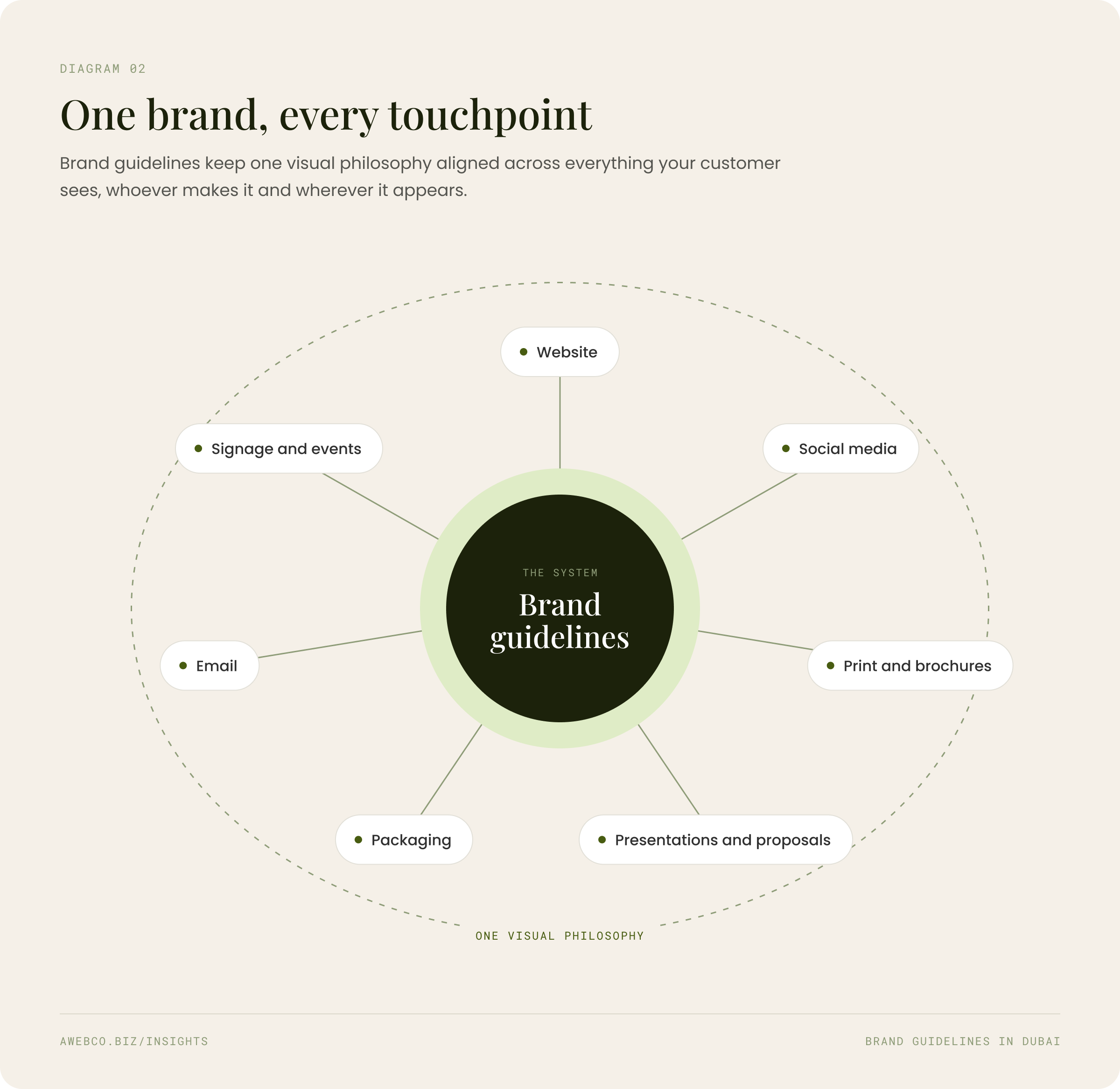
- One visual philosophy, every touchpoint. Guidelines keep your website, social media, print and every other piece of collateral looking and sounding like the same business.
- Most guidelines go unused. The fix is templates, a named owner and rules with examples, not a longer document.
- Consistency now matters to AI search too. Assistants are more confident naming a business that describes itself the same way everywhere.
It is six o'clock, and someone on your team needs an Instagram post out tonight. They open the shared drive and find three versions of the logo, two shades of what is supposed to be the same green, and a font nobody has installed. So they guess. Multiply that guess across a year of posts, proposals, brochures and signage, and you have a brand that looks slightly different every time someone meets it.
Brand guidelines exist to remove that guess. Done well, they make the right choice the easy choice, whether the person designing is your in-house marketer, a freelancer or a print shop in Al Quoz.
At Awebco, we have built and applied brand systems for businesses across the UAE since 2003. This guide covers what brand guidelines should include, why they matter for a business in Dubai, and how to write guidelines people actually follow. There is a ready template in the middle.
QUICK ANSWER
Brand guidelines are a documented set of rules for how a brand looks, sounds and is applied. They cover the logo, colour, typography, tone of voice, imagery and templates for everyday formats, and they keep one visual philosophy aligned across your website, social media, print and every other piece of collateral. The most effective guidelines are short and full of examples. They name an owner and provide ready-made templates, because the gap in most businesses is not the document but whether anyone uses it.
What are brand guidelines?
Brand guidelines, sometimes called a brand style guide or brand book, are the rules that keep your brand recognisable wherever it appears. They record the decisions already made about your identity, so every new piece of work starts from the same place.
Design is a far more organised system of moving parts than most people expect. It needs creative flair, and good work always has it. But underneath the flair sits a set of decisions made in advance: which colours, which type, how much space, which tone, what never to do. Those decisions form a system, and brand guidelines are its best-known form.
“The most ambitious and innovative designs find success when they evolve from a carefully crafted system, rather than a product of randomised chaos.”
Think of them as the difference between a recipe and a photograph of a meal. A logo file shows what the brand looks like once. Guidelines explain how to make it again, correctly, in any size or format.
The Ehrenberg-Bass Institute's work on distinctive brand assets shows why this matters. Colours, shapes, typefaces and taglines only become cues people link to your business when they are used the same way, again and again. Professor Jenni Romaniuk's advice is to make “no” your default answer to changing an asset, unless there is a clear long-term benefit. Brand guidelines are how a business keeps that promise.
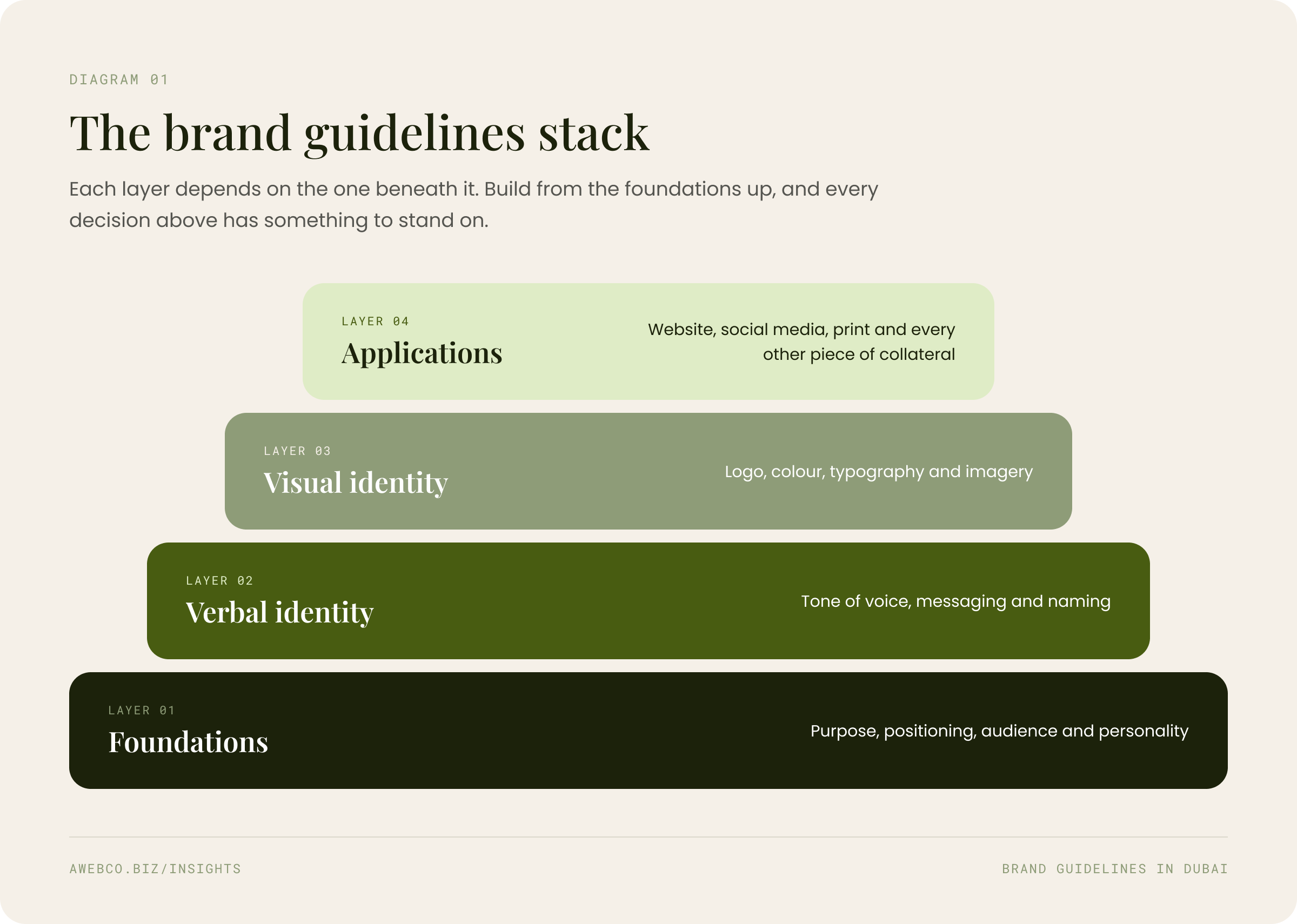
The order matters. When guidelines start with the logo and skip the foundations, the visuals have nothing to anchor them, and every future decision becomes a matter of taste.
What do brand guidelines actually keep aligned?
Everything your customer sees. Brand guidelines keep a brand's visual philosophy consistent across the website, social media, print and every other piece of collateral: brochures, business cards, proposals, presentations, packaging, email signatures, event stands and signage.
Each of those is made at a different time, often by a different person, in a different tool. Without a shared set of rules, each one drifts a little. Customers rarely notice a single inconsistency, but they do notice when a brand never quite feels the same twice.
Why do brand guidelines matter for a business in Dubai?
Every market rewards consistency. Dubai adds a few pressures that make it harder to achieve by instinct.
The market is crowded. In almost every sector, customers can choose between dozens of credible options, and most will meet your brand across several channels before they ever get in touch. A brand that looks consistent across all of them feels established. One that shifts from channel to channel feels smaller than it is.
Many hands touch the brand. Most Dubai businesses rely on a mix of in-house staff, agencies, freelancers and suppliers. Each new pair of hands is a new chance for drift, unless the rules are written down.
The shopfront has rules too. Dubai's Out-of-Home Advertising Manual, issued by the RTA with Dubai Municipality and DET, sets the standard for signage, and DET now enforces it: one trade name per outlet, signage that runs horizontally, and Arabic placed above English. If your signage needs to be bilingual, note it in your guidelines and brief a specialist Arabic designer early, so the contractor is not left to improvise.
The commercial case is well documented. In Marq's research among brand management professionals, respondents estimated that consistent presentation would lift revenue by 10 to 20 per cent. Psychology explains the mechanism. Robert Zajonc showed in 1968 that repeated exposure to the same stimulus makes people feel more positively towards it, and later research found that the more easily people can process something, the more they like it. A consistent brand gives your audience both: more repetition, and less effort to recognise you. There is a newer reason too. As we explain in SEO vs GEO, AI assistants are more confident naming a business whose details and description read the same everywhere. Brand consistency has become a search signal as well as a design one.
What should brand guidelines include? A template
Use this as your branding guidelines template. Each row is a section of the document, with the detail most templates leave out.
| Section | What it settles | The detail most templates miss |
|---|---|---|
| Foundations | Purpose, positioning, audience and personality | A one-line positioning statement the whole team can repeat |
| Logo | Versions, clear space, minimum sizes and misuse | Versions for dark backgrounds, small screens and social profile images |
| Colour | Primary and secondary palettes in HEX, RGB, CMYK and Pantone | Text contrast that meets the WCAG minimum of 4.5:1, and how colours shift between screen and print |
| Typography | Typefaces, sizes, weights and hierarchy | Web fallbacks, and how headings scale down on mobile |
| Tone of voice | How you sound, and the words you use and avoid | How the tone flexes by channel, with written examples |
| Imagery | Photography style, illustration and icons | What to avoid, as well as what to use |
| Applications | Website, social media, print and other collateral | Ready templates for the formats you produce most often |
| Governance | Owner, approvals, file locations and version history | Who signs off work from agencies, freelancers and suppliers |
If you only have time to write four sections, write foundations, logo, colour and typography, then add templates for your three most frequent formats. That covers most of what goes wrong day to day.
How do guidelines stay consistent without becoming rigid?
A common worry is that guidelines will make every post look the same. They should not, and a useful idea from communication research explains why.
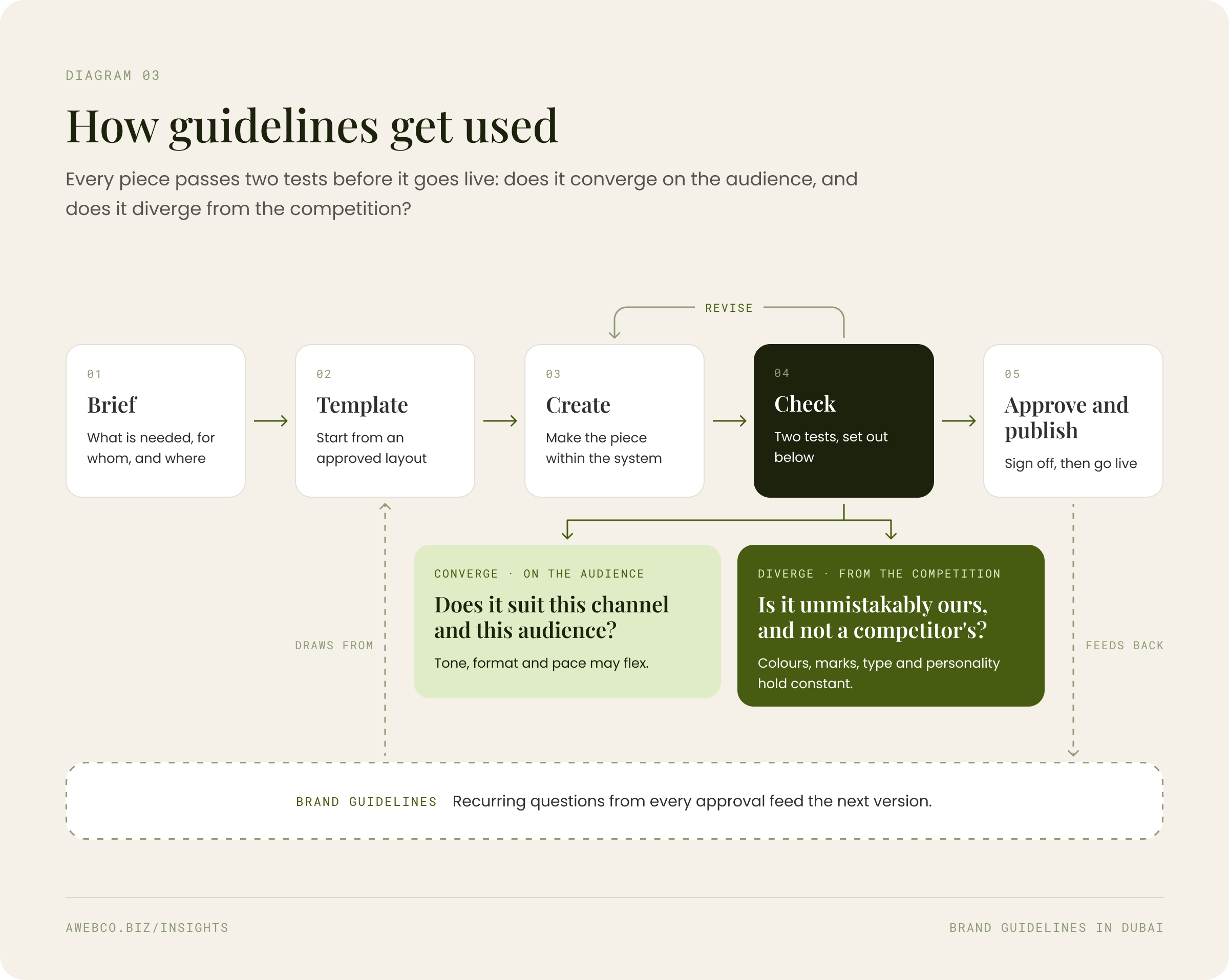
Communication accommodation theory, developed by Howard Giles, describes two moves people make when they communicate. Convergence narrows the distance between speaker and listener. Divergence emphasises difference. A strong brand does both at once.
It converges on the audience. A LinkedIn post, an Instagram reel and a printed brochure speak to people in different moments, so the tone, format and pace can adapt to each. It diverges from the competition. The distinctive assets that set you apart, your colours, marks, typography and personality, stay constant everywhere. Good guidelines say clearly which parts may flex and which never do. When brands get this the wrong way round, every channel sounds the same while the visual identity quietly drifts, and the brand becomes both duller and harder to recognise.
Why do most brand guidelines go unused?
Here is the uncomfortable part. Plenty of businesses have brand guidelines, and plenty of them still publish work that is off-brand. Teams rarely do it on purpose. Marq's analysis of brand governance finds they drift when the right assets take too long to find, when an old version is still sitting in the shared drive, or when content is needed faster than the brand team can supply it. The document is rarely the problem. The system around it is.
Guidelines tend to fail for predictable reasons. You will probably recognise a few of these:
- The document is a 60 page PDF that nobody has opened since launch day.
- It explains rules but shows no examples of them applied.
- There are no templates, so every post is designed from scratch.
- Files live in someone's personal drive, in several versions.
- Nobody owns the guidelines, so nobody updates them.
- Print and digital are managed separately, so they slowly drift apart.
The cause and effect runs in one direction. When the right way takes longer than the quick way, people take the quick way. So good guidelines make the right way faster, with ready templates, one approved file location and a clear route for sign-off.
How to build brand guidelines in six steps
- 01
Audit what already exists. Gather every live touchpoint: website, social media, proposals, print, packaging and signage. The inconsistencies will tell you where the rules are needed most.
- 02
Settle the foundations first. Agree purpose, positioning, audience and personality before anyone opens a design file.
- 03
Design the core assets as a set. Decide logo, colour, type and imagery together, so they work as one system rather than four separate choices.
- 04
Write every rule with an example. Show the correct use next to the incorrect one. A single do and don't image replaces a paragraph of explanation.
- 05
Build templates for your most frequent formats. Social posts, presentations, proposals and email signatures usually cover most daily use.
- 06
Name an owner and set a review date. Review at least once a year, and whenever you rebrand, change your trade name or enter a new market.
How long should brand guidelines be?
As short as they can be while still answering the questions your team actually asks. For most small and mid-sized businesses, that is somewhere between a focused dozen pages and a small living website. Length is not a measure of quality. A 12 page guide with examples and templates will outperform a 60 page PDF every time, because people will open it.
Getting your brand guidelines right
Good brand guidelines are one of the few pieces of design work that save time every week after they are finished. They protect the investment you have made in your identity, keep your website, social media and print speaking with one voice, and give every new colleague or supplier a head start.
Frequently asked questions
What are brand guidelines?
Brand guidelines are a documented set of rules for how a brand looks, sounds and is applied. They typically cover brand foundations, the logo, colour, typography, tone of voice, imagery and templates for everyday formats. Their purpose is to keep the brand consistent regardless of who is creating the work.
Why are brand guidelines important?
They keep a brand's visual philosophy aligned across the website, social media, print and every other piece of collateral. That consistency makes a brand easier to recognise and remember, saves time on every new piece of work, and gives agencies, freelancers and new staff a clear starting point.
What is the difference between brand guidelines and a brand style guide?
In practice, the terms are used interchangeably. Some teams use "style guide" for the visual rules alone and "brand guidelines" for the complete document, including positioning and tone of voice. What matters is that the document covers both how the brand looks and how it speaks.
What should a branding guidelines template include?
At a minimum: brand foundations, logo usage, colour palette, typography, tone of voice, imagery, applications and governance. The template table in this article sets out each section, with the detail most templates miss.
Do brand guidelines cover print as well as digital?
They should. A complete set of guidelines covers the website and social media alongside brochures, business cards, presentations, packaging, email signatures and signage. Print needs its own colour values, such as CMYK and Pantone, so screen and paper match as closely as possible.
Will brand guidelines make our content look repetitive?
Not if they are written well. Good guidelines separate what must stay constant, such as colours, marks and typography, from what can adapt to each channel, such as tone, format and pace. The brand stays recognisable while each piece still suits its audience.
How often should brand guidelines be updated?
Review them at least once a year, and update them whenever you rebrand, change your trade name, enter a new market or launch a sub-brand. Add a new rule wherever the same question comes up more than twice.
How do brand guidelines help with AI search?
AI assistants build a picture of your business from everything published about it. When your name, description and services read the same across your website, listings and profiles, assistants can identify you with more confidence and are more likely to mention you. Brand guidelines that include messaging rules help keep that description consistent.
Can Awebco create brand guidelines for my business?
Yes. We build brand guidelines and templates for businesses across the UAE, and apply them across websites, social media, print and content. Talk to us to discuss your brand.

If your brand has grown faster than its rules, our team can help.
We audit what you have, build the guidelines and templates, and apply them across your website, social media and content.
Talk to usAmaan
Design Head at Awebco
Amaan leads design at Awebco, across brand identities, websites, social and print. He writes here about brand systems and the design decisions behind them.
Amaan on LinkedIn